
Health > EMS > Product reviews
5 Reasons to Ask About Suboccipital Tension and the Vagus Nerve (When You Have Acid Reflux, Heart Palpitations or Vertigo)

Original feature by Rick D. · UK edition by Rivelity
8 April 2026 | 4.11 pm BST
Original feature by Rick D. · UK edition by Rivelity
8 April 2026 | 4.11 pm BST
Summary. Dizziness, heartburn or a feeling of pressure in your throat can be unsettling, especially if your neck also feels tight. The muscles just below the skull are called the suboccipital muscles. They work where the skull meets the top two vertebrae, helping you turn and steady your head. When that area aches, it is natural to wonder whether the sensations are connected.
This feature looks at five questions about upper-neck tension, the vagus nerve and symptoms you might notice elsewhere. It also explains how Rivelity Neckflow Pro combines warmth, massage, EMS and red light at home. Reflux, palpitations and vertigo can have causes of their own. A tight neck alone cannot tell you which one is responsible.
Advertisement feature from Rivelity. UK adaptation of the original article and reader discussion.
1. What Does Pressure at the Base of Your Skull Tell You?
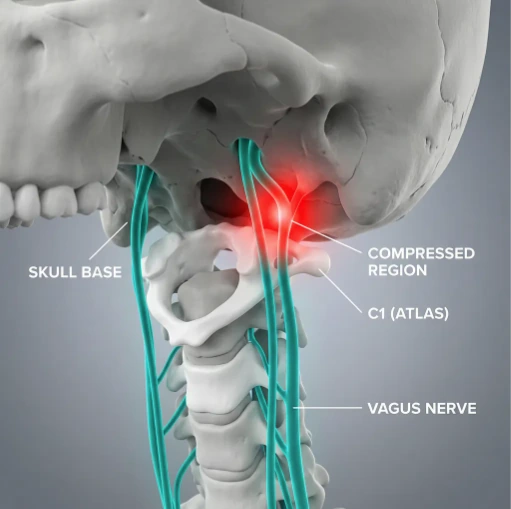
A patch of pressure just below the skull can be hard to pinpoint. You might notice it when turning to look over your shoulder, after leaning towards a screen, or as an ache that creeps towards the back of your head.
This is the cranio-cervical junction, where your skull meets the upper cervical spine. The small muscles around it work whenever you nod, turn or steady your head.
The vagus and glossopharyngeal nerves leave the skull nearby. Their names often come up in discussions about swallowing, digestion or heart rate. The place where you feel sore, however, cannot show whether a nerve is compressed.
If pressure in your neck accompanies repeated vertigo, reflux or palpitations, describe both sensations to your GP. When each one begins, and how long it lasts, can be a useful clue.
2. Why Your Suboccipital Muscles Can Feel So Tight
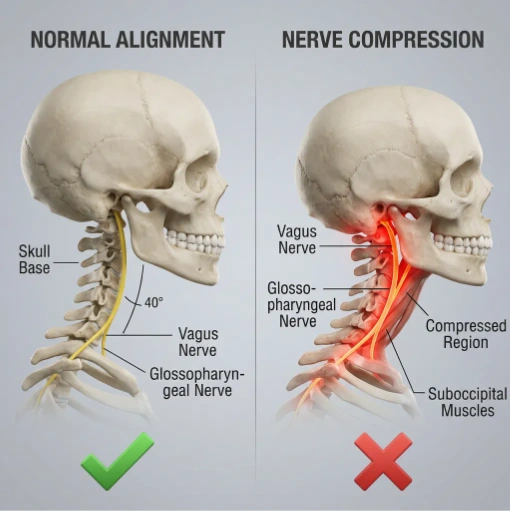
Picture the small movement it takes to glance up from your phone. The suboccipital muscles sit deep beneath the back of the skull and help control precisely that sort of movement.
The first two vertebrae are the atlas and axis, or C1 and C2. Together with the skull above them, they allow remarkably fine adjustments. You can also hold the same muscles in one position for quite a long time without noticing.
Turning your head towards a laptop set off to one side is one example. After an afternoon in that position, the muscles at the back of your neck and across your shoulders may feel tender or stiff.
It is worth noticing which movements ease that stiffness and which bring it back. A sore spot tells you where you feel discomfort. It cannot, by itself, identify a trapped nerve or explain symptoms in the gut or heart.
3. Why Stress and Upper-Neck Tension Can Build Together
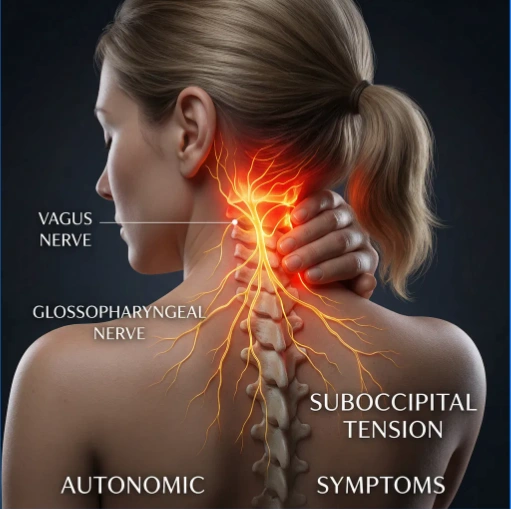
Halfway through a difficult conversation, you realise your jaw is set and your shoulders are nearly touching your ears. The muscles around your neck can stay tense even after the moment has passed.
Stress and poor sleep can contribute to tension headaches. The sensation may spread around both sides of the head, face or neck. A stiff upper neck and a headache can therefore turn up on the same day.
That can feel like a loop. Discomfort makes it harder to settle; an uncomfortable night leaves you more aware of your neck the following morning. It is easy to describe that feeling as being on high alert.
A few minutes in a comfortable position, a break from the screen or gentle movement can make a useful pause. Frequent headaches, persistent dizziness or palpitations deserve an assessment in their own right.
4. Why the Same Symptoms Can Have Different Causes
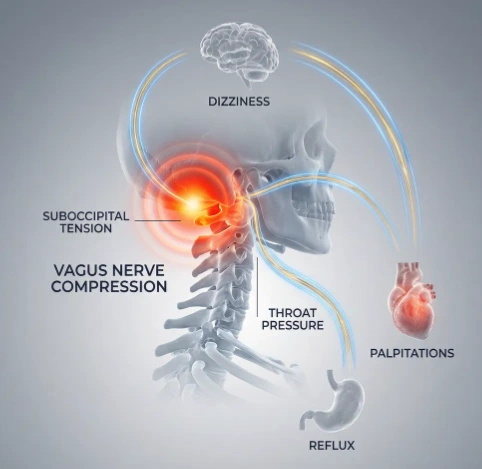
When the back of the head and shoulders feel tight, the discomfort can seem to reach beyond the neck. Headache may accompany it, but reflux, dizziness, throat symptoms and a fluttering heartbeat each have several possible explanations.
Try noting what was happening when a symptom started. Did the room spin as you turned over? Did heartburn follow a meal? Did the palpitations happen at rest? Those details are often more informative than the fact that two symptoms happened on the same day.
It is reasonable to ask about both your neck and any other symptoms at the same appointment. A clinician can decide whether they are related or need separate investigations.
In particular, if you currently have palpitations with chest pain, shortness of breath or a feeling that you may faint, call 999.
5. Feeling Better and Finding the Cause Are Different Things
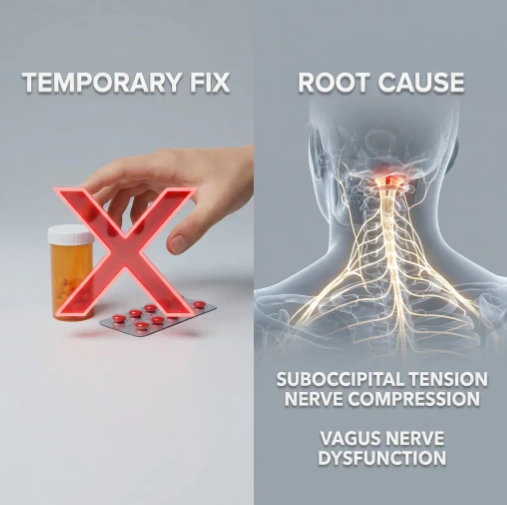
Warmth over a stiff neck or a massage across the back of the shoulders can feel comforting. If your head or neck feels easier afterwards, that is a useful observation about your comfort.
It does not show that the massage changed nerve function, corrected spinal alignment or treated a condition affecting your digestion or heart. The sensations a person notices and the reason they occur are different questions.
The same applies to medicines. Treatments for reflux, migraine or a heart rhythm problem have different purposes. Keep taking prescribed treatment as directed and discuss any changes with the person who prescribed it.
If neck pain lasts for several weeks or new symptoms appear, speak to your GP or physiotherapist. You can still describe which positions, movements or kinds of warmth you find comfortable.
What Can You Do About Upper-Neck Tension?
1. What Does Pressure at the Base of Your Skull Tell You?
A patch of pressure just below the skull can be hard to pinpoint. You might notice it when turning to look over your shoulder, after leaning towards a screen, or as an ache that creeps towards the back of your head.
This is the cranio-cervical junction, where your skull meets the upper cervical spine. The small muscles around it work whenever you nod, turn or steady your head.
The vagus and glossopharyngeal nerves leave the skull nearby. Their names often come up in discussions about swallowing, digestion or heart rate. The place where you feel sore, however, cannot show whether a nerve is compressed.
If pressure in your neck accompanies repeated vertigo, reflux or palpitations, describe both sensations to your GP. When each one begins, and how long it lasts, can be a useful clue.
2. Why Your Suboccipital Muscles Can Feel So Tight
Picture the small movement it takes to glance up from your phone. The suboccipital muscles sit deep beneath the back of the skull and help control precisely that sort of movement.
The first two vertebrae are the atlas and axis, or C1 and C2. Together with the skull above them, they allow remarkably fine adjustments. You can also hold the same muscles in one position for quite a long time without noticing.
Turning your head towards a laptop set off to one side is one example. After an afternoon in that position, the muscles at the back of your neck and across your shoulders may feel tender or stiff.
It is worth noticing which movements ease that stiffness and which bring it back. A sore spot tells you where you feel discomfort. It cannot, by itself, identify a trapped nerve or explain symptoms in the gut or heart.
3. Why Stress and Upper-Neck Tension Can Build Together
Halfway through a difficult conversation, you realise your jaw is set and your shoulders are nearly touching your ears. The muscles around your neck can stay tense even after the moment has passed.
Stress and poor sleep can contribute to tension headaches. The sensation may spread around both sides of the head, face or neck. A stiff upper neck and a headache can therefore turn up on the same day.
That can feel like a loop. Discomfort makes it harder to settle; an uncomfortable night leaves you more aware of your neck the following morning. It is easy to describe that feeling as being on high alert.
A few minutes in a comfortable position, a break from the screen or gentle movement can make a useful pause. Frequent headaches, persistent dizziness or palpitations deserve an assessment in their own right.
4. Why the Same Symptoms Can Have Different Causes
When the back of the head and shoulders feel tight, the discomfort can seem to reach beyond the neck. Headache may accompany it, but reflux, dizziness, throat symptoms and a fluttering heartbeat each have several possible explanations.
Try noting what was happening when a symptom started. Did the room spin as you turned over? Did heartburn follow a meal? Did the palpitations happen at rest? Those details are often more informative than the fact that two symptoms happened on the same day.
It is reasonable to ask about both your neck and any other symptoms at the same appointment. A clinician can decide whether they are related or need separate investigations.
In particular, if you currently have palpitations with chest pain, shortness of breath or a feeling that you may faint, call 999.
5. Feeling Better and Finding the Cause Are Different Things
Warmth over a stiff neck or a massage across the back of the shoulders can feel comforting. If your head or neck feels easier afterwards, that is a useful observation about your comfort.
It does not show that the massage changed nerve function, corrected spinal alignment or treated a condition affecting your digestion or heart. The sensations a person notices and the reason they occur are different questions.
The same applies to medicines. Treatments for reflux, migraine or a heart rhythm problem have different purposes. Keep taking prescribed treatment as directed and discuss any changes with the person who prescribed it.
If neck pain lasts for several weeks or new symptoms appear, speak to your GP or physiotherapist. You can still describe which positions, movements or kinds of warmth you find comfortable.
When the muscles below the skull feel tight, it is worth paying attention to how you support and move your head. Three small changes can make the day more comfortable.
✓ Bring your screen or reading material into your line of sight so your head can rest in a comfortable position.
✓ Change position throughout the day. Long stretches with your head held still can leave the upper neck and shoulders feeling stiff.
✓ Try gentle warmth or massage if you find it comfortable. Keep your neck moving within a range that feels right for you.
Rivelity Neckflow Pro is designed for people who enjoy that warmth and massage at home, with the controls close to hand.
What Can You Do About Upper-Neck Tension?
When the muscles below the skull feel tight, it is worth paying attention to how you support and move your head. Three small changes can make the day more comfortable.
✓ Bring your screen or reading material into your line of sight so your head can rest in a comfortable position.
✓ Change position throughout the day. Long stretches with your head held still can leave the upper neck and shoulders feeling stiff.
✓ Try gentle warmth or massage if you find it comfortable. Keep your neck moving within a range that feels right for you.
Rivelity Neckflow Pro is designed for people who enjoy that warmth and massage at home, with the controls close to hand.
Neckflow Pro Massages the Back of Your Neck While You Relax
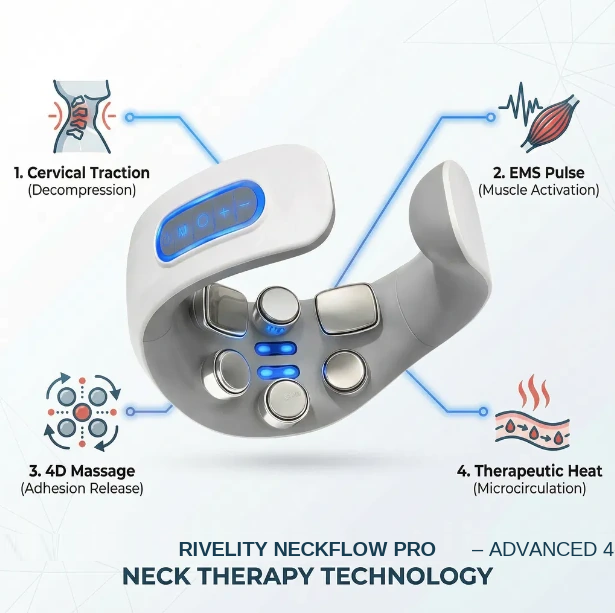
Rivelity Neckflow Pro brings together heat, EMS, vibration and red light in a cordless neck massager. Here is how its different parts work.
- Curved neck support The band sits around the back of the neck and holds the massage heads in contact while you settle into a comfortable position.
- Electrical muscle stimulation (EMS) The contact pads deliver adjustable pulses. Use the controls to choose the intensity you prefer.
- Floating massage heads The individual heads follow the contours at the back of the neck, keeping the contact surfaces close without having to hold the massager in place.
- Adjustable massage modes Use the side controls to work through the modes and find a rhythm you like. You can adjust the settings during the session.
- Vibration massage Gentle movement across the contact area adds a different sensation to the pulses, particularly after time spent sitting in one position.
- Red light Small built-in red lights sit between the massage contacts on the Pro model. They work alongside its warmth, vibration and EMS features.
- Warming contact pads Choose the heat setting that feels comfortable. The rechargeable unit is cordless during use; follow the directions supplied for positioning and session length.

Try Rivelity Neckflow Pro With a 90-Day Money-Back Guarantee
Rivelity Neckflow Pro is available to order for £89.54 in the UK. The handheld controls let you choose warmth, vibration and EMS intensity while the curved band rests around your neck.
The current UK offer includes free gifts and free standard delivery. Choose your model on the product page to see what is included before you order.
Want to try it for yourself?
Rivelity’s 90-day money-back guarantee starts on the day your order arrives. The product page explains how to contact the team if it is not right for you.
Neckflow Pro Massages the Back of Your Neck While You Relax
Rivelity Neckflow Pro brings together heat, EMS, vibration and red light in a cordless neck massager. Here is how its different parts work.
- Curved neck support The band sits around the back of the neck and holds the massage heads in contact while you settle into a comfortable position.
- Electrical muscle stimulation (EMS) The contact pads deliver adjustable pulses. Use the controls to choose the intensity you prefer.
- Floating massage heads The individual heads follow the contours at the back of the neck, keeping the contact surfaces close without having to hold the massager in place.
- Adjustable massage modes Use the side controls to work through the modes and find a rhythm you like. You can adjust the settings during the session.
- Vibration massage Gentle movement across the contact area adds a different sensation to the pulses, particularly after time spent sitting in one position.
- Red light Small built-in red lights sit between the massage contacts on the Pro model. They work alongside its warmth, vibration and EMS features.
- Warming contact pads Choose the heat setting that feels comfortable. The rechargeable unit is cordless during use; follow the directions supplied for positioning and session length.
Try Rivelity Neckflow Pro With a 90-Day Money-Back Guarantee
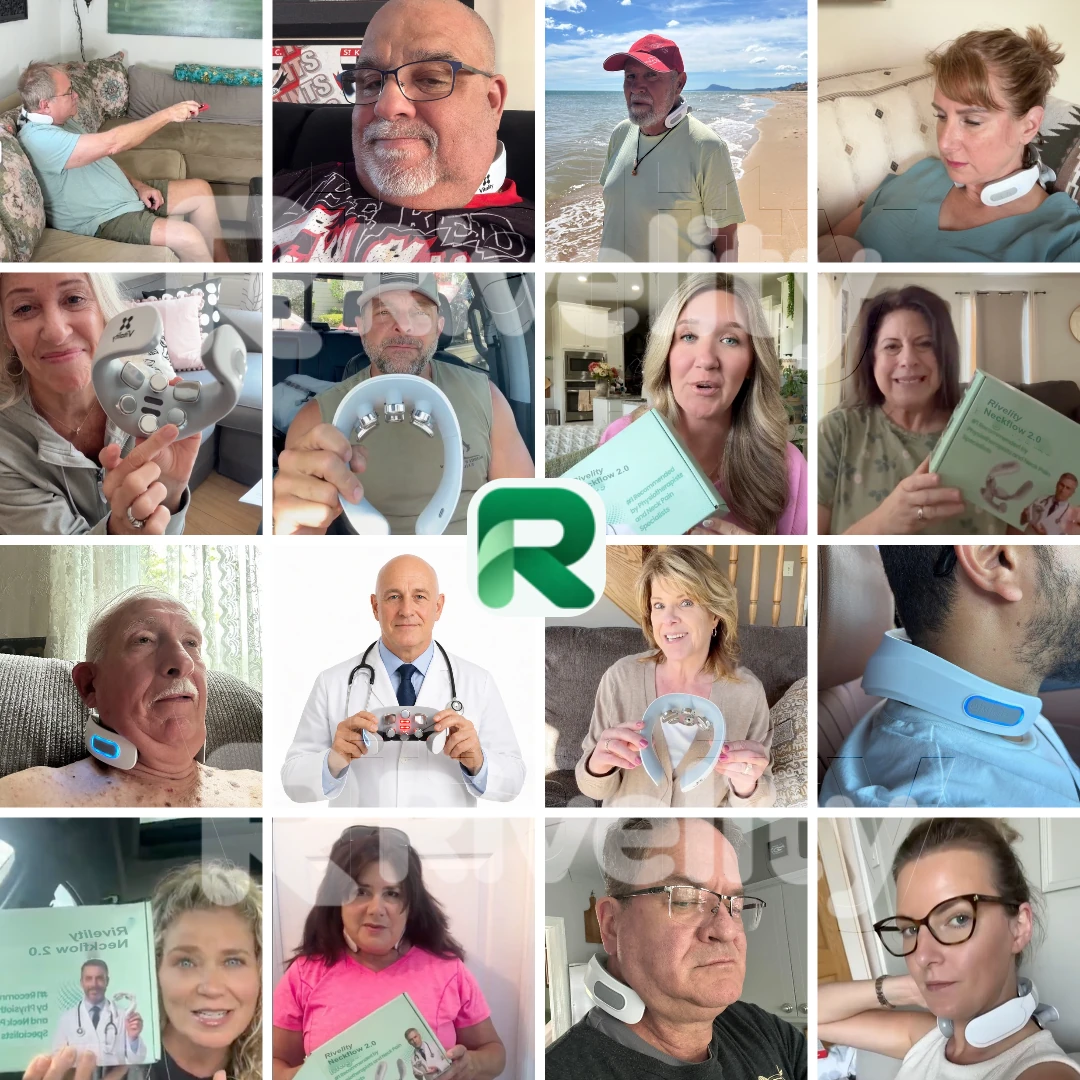
Rivelity Neckflow Pro is available to order for £89.54 in the UK. The handheld controls let you choose warmth, vibration and EMS intensity while the curved band rests around your neck.
The current UK offer includes free gifts and free standard delivery. Choose your model on the product page to see what is included before you order.
Want to try it for yourself?
Rivelity’s 90-day money-back guarantee starts on the day your order arrives. The product page explains how to contact the team if it is not right for you.
Discover Rivelity Neckflow Pro, the 4-in-1 Neck Massager
🎁 Free Gifts With Your Order
50% OFF UK OFFER!
Rivelity Neckflow Pro is £89.54, reduced from £179.16. Check availability for your UK order.
UK PRICE £89.54 | STANDARD DELIVERY FREE

4.8 out of 5
3,791 ratings in the original advertorial
5 Star

90%
4 Star

7%
3 Star

2%
2 Star

0%
1 Star

1%
Media shown in the original feature

Try it today with a 90-Day Money-Back Guarantee!
4.8 out of 5
3,791 ratings in the original advertorial
5 Star
90%
4 Star
7%
3 Star
2%
2 Star
0%
1 Star
1%
Media shown in the original feature
🎁 Free Gifts With Your Order
50% OFF UK OFFER!
Rivelity Neckflow Pro is £89.54, reduced from £179.16. Check availability for your UK order.
RIVELITY UK OFFER
UK PRICE £89.54 | STANDARD DELIVERY FREE
Try it today with a 90-Day Money-Back Guarantee!
Comments
These 16 comments are adapted from the original reader discussion in UK English. They describe personal experiences, not verified Rivelity purchases or medical advice.

Wilma Devon
Has anyone tried it for vestibular migraines or ocular migraines?


Harriet Preston
I use mine just below the back of my head. That heavy, dizzy feeling I sometimes get before a migraine seems less intense, and I’ve noticed less pressure around my eyes and less nausea. I do some gentle neck stretches as well. Between the two, my days have felt quite different. I just wanted to share how it’s been for me.


Lottie Baldwin
I’ve had mine a couple of weeks. I’ve tried it in different positions to reach the base of my skull and a little further down my neck. My stomach and my mood have felt better too. I’ve also been using a separate neck sling, so that’s part of what I’ve been doing. I’m really pleased with how I’m feeling.


Amelia Carter
Where are the orders dispatched from?


Poppy Delaney
Hi Amelia, mine was sent from within my own country and turned up a few days after I ordered it.


Leah Nicholson
I really like mine, thank you! Neck and jaw tension and headaches are what made me try it. I’m glad I did.


Vanessa Brooks
Both my ears have felt full for six months and I get a sound like static in my right ear. I’ve been told it might be Eustachian tube dysfunction. My neck and jaw always feel tense, although I don’t get pain there. Has anyone else had that experience?


Oliver Williams
What surprised me was how much I liked the combination of EMS, warmth and vibration. I used to have pain all the time and was seeing my chiropractor more often than I do now.


Alfie Crawford
I’ve seen neurologists and other doctors about trigeminal neuralgia on one side and nerve pain after shingles on the other. I even had shingles inside my mouth. I’d never heard anyone mention Eagle syndrome before. I’ve spent years looking for an explanation for the pain in my throat and glands. Thanks for the information. I’ve started using Neckflow Pro and it seems to be helping me.


Daisy Peterson
Does anyone know about using this with spinal stenosis, or after spinal fusion? I have a Harrington rod for scoliosis and my spine is fused from T2 downwards.


Freya Vaughan
I have cervical spinal stenosis, two herniated discs and a bulging disc. Some days the pain makes everyday things really difficult. I’ve felt more comfortable using the massager and I’ve been able to get on with my usual routine.


Eliza Hayes
I’ve had pressure at the base of my skull alongside vertigo and a racing heart. I wondered about the vagus nerve too. Since I started using Neckflow Pro, I’ve noticed the pressure easing and those spells feeling less intense. That’s been my experience personally.

Sophie Barrett
How have other people got on with it? I recognise all the symptoms in the video, but I’m still quite sceptical.

Ruby Chamberlain
I was sceptical too, Sophie. I had neck pain all the time, felt dizzy when I stood up and had a full feeling in my throat that nobody could explain. A couple of weeks after I started using Neckflow Pro, the tightness at the back of my head began to ease. The nausea and headaches haven’t been disrupting my days as much either.


Rosie Gallagher
I live with gastroparesis. I was surprised that my digestion felt easier around the time I tried Neckflow Pro. I wondered if that had something to do with the vagus nerve.

Whitney Morris
I’ve had a cervical fusion and I’d been told to avoid traction, so I was nervous about trying anything on my neck. The warmth and gentle stimulation were the parts I liked. I felt less tight afterwards.
Comments
These 16 comments are adapted from the original reader discussion in UK English. They describe personal experiences, not verified Rivelity purchases or medical advice.
Wilma Devon
Has anyone tried it for vestibular migraines or ocular migraines?
Harriet Preston
I use mine just below the back of my head. That heavy, dizzy feeling I sometimes get before a migraine seems less intense, and I’ve noticed less pressure around my eyes and less nausea. I do some gentle neck stretches as well. Between the two, my days have felt quite different. I just wanted to share how it’s been for me.
Lottie Baldwin
I’ve had mine a couple of weeks. I’ve tried it in different positions to reach the base of my skull and a little further down my neck. My stomach and my mood have felt better too. I’ve also been using a separate neck sling, so that’s part of what I’ve been doing. I’m really pleased with how I’m feeling.
Amelia Carter
Where are the orders dispatched from?
Poppy Delaney
Hi Amelia, mine was sent from within my own country and turned up a few days after I ordered it.
Leah Nicholson
I really like mine, thank you! Neck and jaw tension and headaches are what made me try it. I’m glad I did.
Vanessa Brooks
Both my ears have felt full for six months and I get a sound like static in my right ear. I’ve been told it might be Eustachian tube dysfunction. My neck and jaw always feel tense, although I don’t get pain there. Has anyone else had that experience?
Oliver Williams
What surprised me was how much I liked the combination of EMS, warmth and vibration. I used to have pain all the time and was seeing my chiropractor more often than I do now.
Alfie Crawford
I’ve seen neurologists and other doctors about trigeminal neuralgia on one side and nerve pain after shingles on the other. I even had shingles inside my mouth. I’d never heard anyone mention Eagle syndrome before. I’ve spent years looking for an explanation for the pain in my throat and glands. Thanks for the information. I’ve started using Neckflow Pro and it seems to be helping me.
Daisy Peterson
Does anyone know about using this with spinal stenosis, or after spinal fusion? I have a Harrington rod for scoliosis and my spine is fused from T2 downwards.
Freya Vaughan
I have cervical spinal stenosis, two herniated discs and a bulging disc. Some days the pain makes everyday things really difficult. I’ve felt more comfortable using the massager and I’ve been able to get on with my usual routine.
Eliza Hayes
I’ve had pressure at the base of my skull alongside vertigo and a racing heart. I wondered about the vagus nerve too. Since I started using Neckflow Pro, I’ve noticed the pressure easing and those spells feeling less intense. That’s been my experience personally.
Sophie Barrett
How have other people got on with it? I recognise all the symptoms in the video, but I’m still quite sceptical.
Ruby Chamberlain
I was sceptical too, Sophie. I had neck pain all the time, felt dizzy when I stood up and had a full feeling in my throat that nobody could explain. A couple of weeks after I started using Neckflow Pro, the tightness at the back of my head began to ease. The nausea and headaches haven’t been disrupting my days as much either.
Rosie Gallagher
I live with gastroparesis. I was surprised that my digestion felt easier around the time I tried Neckflow Pro. I wondered if that had something to do with the vagus nerve.
Whitney Morris
I’ve had a cervical fusion and I’d been told to avoid traction, so I was nervous about trying anything on my neck. The warmth and gentle stimulation were the parts I liked. I felt less tight afterwards.
This advertisement gives general product information. Symptoms such as persistent neck pain, dizziness, reflux or palpitations can have different causes. Speak to your GP or another qualified health professional for advice about your own symptoms.
If you have an implanted medical device, have had spinal surgery or have been advised to avoid neck stimulation, ask the clinician looking after you before using the massager. In a medical emergency, call 999.
© 2026 Rivelity UK · Privacy policy · Terms enquiries
 Original publisher’s badge
Get Up to 50% OFF Today